About one percent of the population has celiac disease, and 10 to 15 percent can’t tolerate lactose. Which substitutes actually work, with a swap table and baking fixes.
How do you cook with allergies and intolerances?
Cooking with allergies works through systematic substitution, not giving things up: for almost every critical ingredient, there’s an alternative with a comparable function. What matters is knowing the ingredient’s role in the recipe: does it bind, does it add lift, does it bring moisture or flavor?
The key points:
- Celiac disease affects about 1 percent of the population according to recent studies, with a high number of undiagnosed cases.
- Lactose intolerance affects about 10 to 15 percent of people in Germany.
- Hidden allergens often hide in ready-made sauces, spice blends, and cured meats; reading ingredient lists is essential.
- Gluten-free baking is missing the binding protein; psyllium husk or ground flaxseed can take over that job.
Good to Know
This article doesn’t replace a medical diagnosis. If you suspect an intolerance, have it checked by a doctor before changing your diet; for celiac disease this is essential, because testing requires you to still be eating gluten.
What are the most common intolerances?
| Intolerance | Trigger | Prevalence in Germany |
|---|---|---|
| Lactose intolerance | Milk sugar | approx. 10–15% |
| Celiac disease | Gluten in wheat, rye, barley | approx. 1% (many undiagnosed) |
| Histamine intolerance | Aged foods, wine, cheese | estimated, no confirmed figure |
| Fructose malabsorption | Fruit sugar | common, often undiagnosed |
| Nut allergy | Tree nuts and peanuts | a true allergy, can be severe |
The distinction matters: an allergy is an immune system reaction and can be life-threatening. An intolerance comes from missing or slow-working enzymes; unpleasant, but not acutely dangerous. Celiac disease is a special case: an autoimmune condition where even tiny amounts of gluten damage the lining of the gut.
Where do allergens hide?
The critical ingredients rarely show up where you’d expect them. Especially easy to miss:
- Gluten in soy sauce, ready-made sauces, spice blends, cured meats, breaded products, and some French fries
- Lactose in sausage, packaged soups, spreads, chips, and as a carrier in medications
- Nuts in nougat, pesto, granola bars, Asian sauces, and baked goods through cross-contact
- Egg in pasta, mayonnaise, breading, baked goods, and as a fining agent in drinks
In the EU, the 14 major allergens have to be highlighted on the ingredient list. For loose food and in restaurants, businesses are required to disclose them on request; it’s always worth asking.
Which alternatives actually work?
| Instead of | Alternative | Watch out for |
|---|---|---|
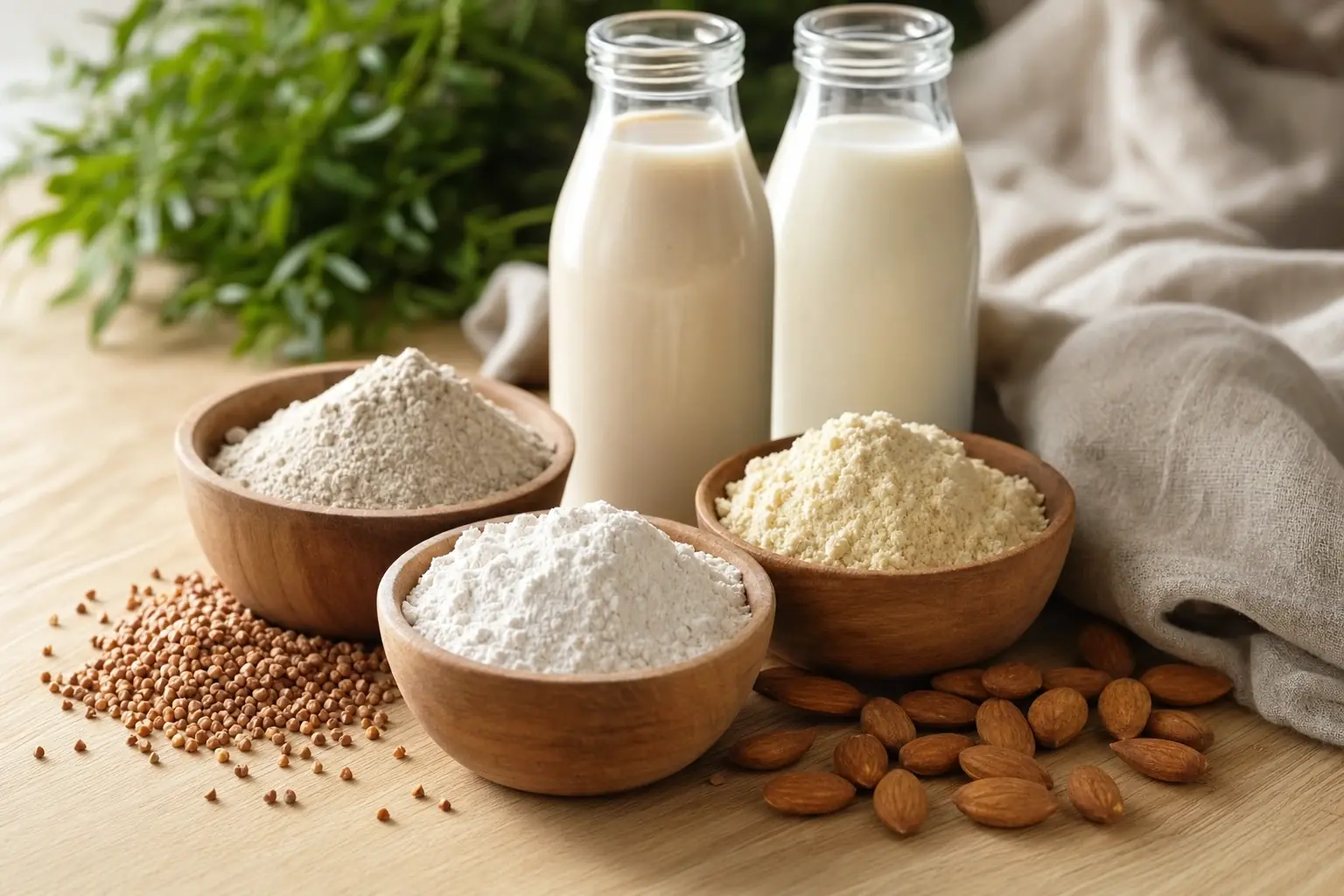
| Cow’s milk | Oat, almond, soy, or rice drink | With celiac disease, choose certified gluten-free oats |
| Cream | Oat cream, coconut milk, cashew cream | Coconut brings its own flavor |
| Butter | Dairy-free margarine, oil | Watch the fat content when baking |
| Wheat flour | A blend of rice, buckwheat, and corn flour | A single flour alone makes for crumbly dough |
| Chicken egg (binding) | Flax or chia gel, applesauce | 1 tbsp ground + 3 tbsp water = 1 egg |
| Chicken egg (leavening) | Aquafaba (chickpea water) | Whips up like egg whites |
| Soy sauce | Tamari | Usually gluten-free; check the label |
| Nuts as a topping | Sunflower and pumpkin seeds | Toasts similarly, same texture |
Kitchen Tip
Gluten-free baking is missing the binding protein that keeps dough elastic. One to two teaspoons of psyllium husk per 500 grams of flour blend takes over that job; the dough turns pliable instead of crumbly.
How do you avoid cross-contamination?
For celiac disease and severe allergies, even traces matter. In a mixed household, clear separation helps:
- 1Separate kitchen tools for critical areas: your own toaster, cutting board, and pasta pot.
- 2Cooking order: prepare the allergen-free version first, then the rest, never the other way around.
- 3Store separately and label everything, with allergen-free products on the top shelf so crumbs can’t fall into them.
- 4Avoid wooden boards and scratched plastic boards: residue collects in the grooves.
- 5Keep spreads in their own containers, since a knife that carries back bread crumbs contaminates the whole jar.
How does a cooking app help with allergies?
le’Chef accounts for 13 allergens in your nutrition profile, for every user, including on the free plan. Enter your intolerances once into your le’Chef profile, and the app hides unsuitable recipes instead of just flagging them.
On top of that:
- An allergen warning right on the recipe, before you start cooking
- Ingredient substitution: if a recipe calls for something you can’t have, the AI suggests a substitute with the right quantity
- The AI cooking chat knows your profile and keeps allergens strictly out of its suggestions
“Thanks to le’Chef, I’ve learned that gluten-free baking isn’t rocket science. The recipe suggestions always turn out great!” - Maria, Supporter
Frequently asked questions
What’s the difference between an allergy and an intolerance?
With an allergy, the immune system reacts to a protein, and even tiny amounts can trigger a severe reaction. With an intolerance, an enzyme is missing or working too slowly, so symptoms depend on the amount eaten. Celiac disease is strictly speaking neither; it’s an autoimmune condition.
How many people in Germany have celiac disease?
Recent studies estimate about one percent of the population. The number of undiagnosed cases is considered high, because the condition causes very varied and sometimes nonspecific symptoms and often goes unrecognized for a long time.
Are oats gluten-free?
Oats naturally contain no gluten in the strict sense, but they’re often processed on equipment that also handles wheat. For people with celiac disease, only oats certified gluten-free are suitable.
What can I use to replace eggs when baking?
It depends on what the egg is doing. For binding, one tablespoon of ground flaxseed or chia seeds with three tablespoons of water works well, as does applesauce or mashed banana. For leavening, aquafaba (the liquid from a can of chickpeas) whips up like egg whites.
Do I have to give up dairy completely with lactose intolerance?
Usually not. Many people can tolerate small amounts, and long-aged hard cheeses like Parmesan or mountain cheese contain almost no lactose. Yogurt and kefir are also often tolerated better, since the bacteria in them have already broken down some of the milk sugar.
Sources
- Deutsche Zöliakie-Gesellschaft (German Celiac Society): What is celiac disease?
- Arzneimittelkommission der deutschen Ärzteschaft (Drug Commission of the German Medical Association): Celiac disease
Keep reading: Healthy cooking with little time · Meal prep for beginners